






AI is accelerating demand for coherent optics — but not toward a single architecture. Ciena’s Helen Xenos explains that as networks optimize for power, density, spectral efficiency, and deployment velocity, coherent technology is evolving along multiple paths simultaneously.
What does AI mean for the future evolution of coherent optics? We have previously explored how AI is reshaping optical networks and driving innovation in photonic line systems, such as RLS Hyper-Rail, but what does this mean for coherent optics? With growing data center focus on power efficiency, will all applications eventually move to coherent pluggables? Or will performance-optimized transponders continue to play an important role?
The reality is more nuanced — and more exciting.
Demand for coherent optics is growing at an unprecedented pace across a rapidly expanding range of applications, architectures, and deployment models. As network operators optimize for different constraints — from spectral efficiency to power and space efficiency to deployment velocity — coherent technology is evolving along multiple paths and into a broader range of form factors than ever before.
Before discussing the different implementation approaches moving forward, it is important to take a step back and start — as we always do — with understanding the customer problem we need to solve.
- Is power efficiency the top priority?
- Is maximizing density — delivering the most capacity in the smallest space — the key requirement?
- Do you need to support a specific reach at a given line rate, such as 400G connectivity across every link in the network?
- Is fiber limited or expensive to secure?
- Or is the priority operational simplicity and deployment velocity?
The answer to these questions determines the optimal technology choice.
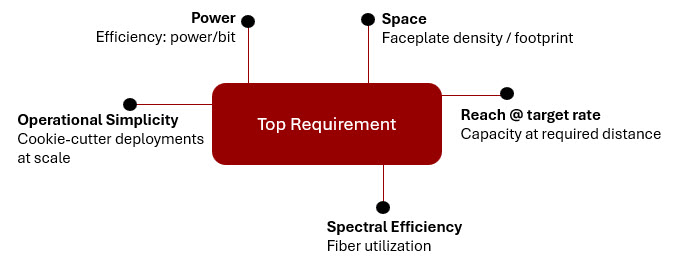
What problem are we solving?
Spectral efficiency still matters
When fiber is limited or expensive to secure, spectral efficiency becomes critical. For these applications, performance-optimized transponders still offer a clear advantage because they are not constrained by the tight power envelopes required for pluggables, enabling the use of more sophisticated DSP techniques to deliver higher fiber capacity than pluggable solutions.
As an example, while 1.6T coherent pluggables do not yet exist, Ciena’s WaveLogic 6 Extreme (WL6e) 1.6T performance optics have been shipping for more than 18 months and are now deployed in over 100 customer networks worldwide. WL6e is widely used in long-haul and submarine networks, as expected, but also anywhere fiber availability is constrained.
In fact, an increasing number of neoscalers are deploying WL6e in metro DCI networks to achieve 50% more capacity per fiber compared to pluggable-based approaches.
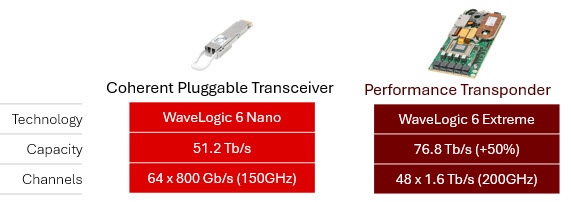
Performance comparison - Metro DCI application
So what comes next for performance transponders?
New use cases such as quantum-safe networking and network sensing are already emerging. At the same time, higher-bandwidth components beyond 130 GHz will enable high-baud 300 GHz and 400 GHz spaced coherent solutions, further driving down transport cost per bit. In these systems, as few as 16 or 12 transceiver pairs could fully populate the entire C-band.
Coherent pluggables continue expanding
At the same time, coherent pluggables have fundamentally reshaped network architectures and are now a critical part of modern optical networks.
They deliver exceptional power and space efficiency, simplify network design through direct integration with routers, and have enabled a robust multivendor ecosystem. As a result, coherent pluggables have dramatically expanded the market for coherent transceivers and accelerated coherent adoption across a much broader range of applications.
And as new capabilities and higher levels of performance continue to be integrated into pluggables, cloud and service providers are deploying them across an expanding set of platforms, architectures, and applications.
Today, 400G coherent pluggables are deployed at massive scale — WaveLogic 5 Nano alone is deployed in more than 300 customer networks worldwide. 800G coherent pluggables are now ramping at an unprecedented pace, driven by scale-across applications. WaveLogic 6 Nano C- and L-band pluggables are already shipping in volume to support these deployments.
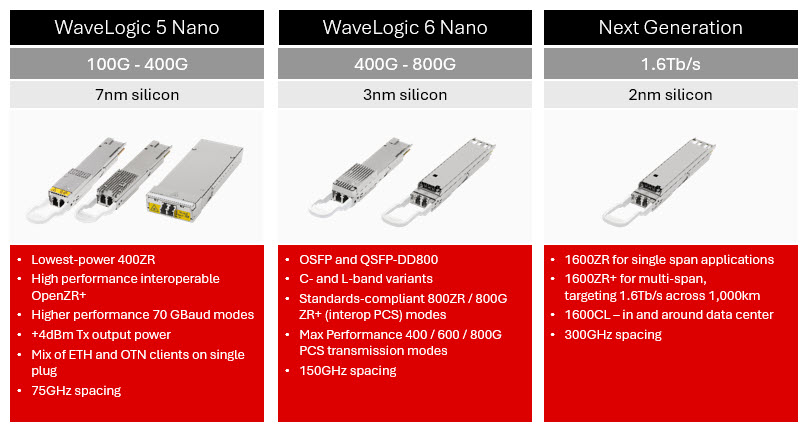
And coherent pluggables continue to evolve.
1.6T pluggables are on the horizon, and coherent optics will continue expanding into new use cases, including short-reach 10–20 km campus interconnect applications with cost-, power-, and latency-optimized coherent-lite designs.
Interestingly, some of the advanced DSP techniques originally developed for performance-optimized transponders — including probabilistic constellation shaping innovations used in WL6e — are now being simplified and repurposed for power-optimized interoperable 1600ZR+ pluggable designs.
Power and density become the new scaling limits
But as coherent pluggables scale to higher capacities, new system-level constraints are emerging that will shape network architectures moving forward.
Router capacity continues to scale rapidly, moving from 51.2 Tb/s to 102.4 Tb/s and now toward 204.8 Tb/s. However, faceplate density does not scale at the same rate. A typical 1RU router remains constrained to roughly 32 OSFP ports, creating hard limits on density.
At the same time, coherent pluggable power consumption is rapidly approaching the practical limits of air cooling.
Increasingly, the challenge is no longer optical technology itself — it is power and faceplate density.
As a result, the industry is pursuing two new architectural paths that will have a direct impact on the evolution of coherent optics.
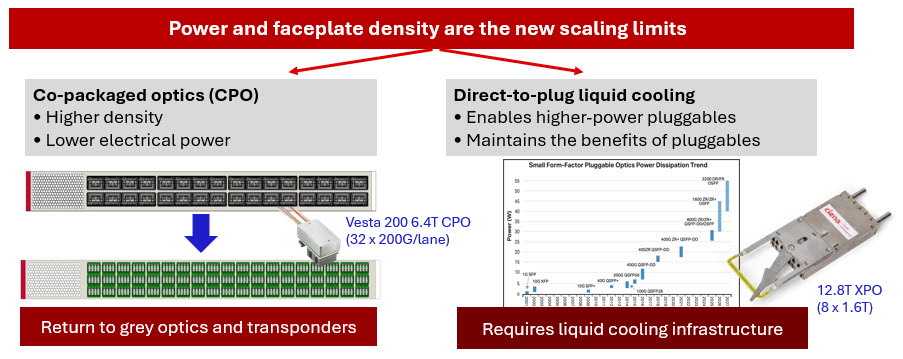
One approach is co-packaged optics (CPO), where non-retimed optics move closer to the switch/XPU silicon to improve density and significantly reduce power consumption. This enables extremely high front-panel I/O density. For example, Ciena’s Vesta 200 6.4T CPX optical engine is designed to support next-generation 204.8T switches while saving 2kW versus legacy, retimed systems.
At the same time, this approach shifts transport architectures back toward routers with IMDD optics and external coherent transponders.
Another approach is to use liquid cooling, which allows higher-power coherent pluggables to remain on the router faceplate while preserving many of the operational advantages that pluggables have enabled.
The trade-off, of course, is the need for liquid-cooling infrastructure.
Examples range from platform-designed liquid-cooled cold plates used with riding heat sink (RHS) OSFPs, to direct-to-plug liquid-cooled OSFPs, to the recently announced XPO (eXtra-dense Pluggable Optics). XPO is a 12.8 Tb/s liquid-cooled pluggable optics module that delivers four times the front-panel density of current OSFP optics and supports densities of up to 204.8 Tb/s per rack unit.
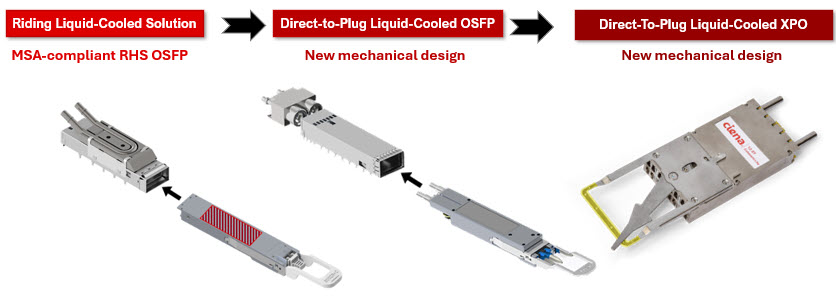
Examples of liquid-cooled pluggable transceiver options
Deployment velocity is driving new architectures
Another emerging implementation approach is being driven not by density, but by operational scale and deployment velocity.
The urgency to rapidly turn up massive amounts of network capacity is becoming a defining requirement for many AI infrastructure deployments.
Traditionally, transport capacity has been deployed one wavelength at a time, requiring large numbers of coherent transceivers to fully populate a fiber pair. But as AI networks increasingly require tens or even hundreds of fibers of capacity to be deployed simultaneously, that wavelength-by-wavelength operational model becomes increasingly inefficient.
In response, the industry is evaluating new integrated full-spectrum transponder (FST) architectures that light the entire fiber at once.
While this approach returns to grey optics attached to coherent transponders, it dramatically simplifies deployment, reduces operational complexity, and minimizes dependence on DWDM expertise by collapsing many wavelength-level operations into a single managed line interface.
Another important advantage is that, without the tight thermal and power constraints imposed by pluggable form factors, higher-performance coherent designs become possible.
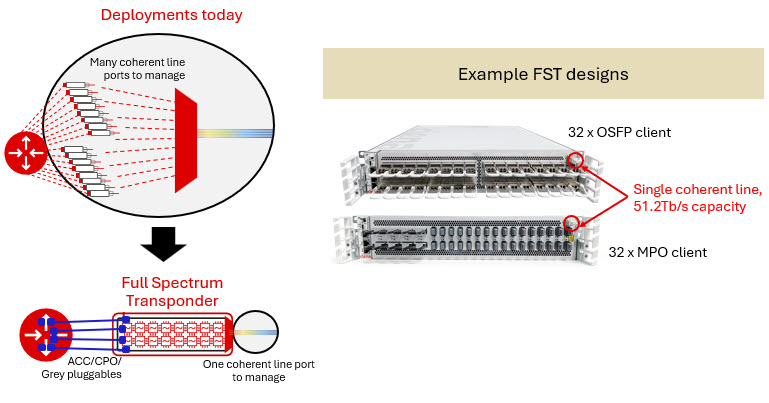
As with coherent pluggables, multiple FST designs are expected to emerge and co-exist to address different customer requirements and operational priorities. One example is a platform architecture populated with mini pluggable transponders—sometimes referred to as media converters—based on standard ELSFP form factors.
Multiple paths forward
So where does coherent optics go from here?
The answer is not a single architecture or form factor.
Different constraints — whether spectral efficiency, power efficiency, density, thermal scaling, operational simplicity, or deployment velocity — are driving different optimal implementations. As coherent technology continues to expand into new applications, we expect to see coherent pluggables, performance transponders, co-packaged optics, liquid-cooled pluggables, and full-spectrum systems all play important roles moving forward.
What is becoming increasingly clear is that coherent optics is no longer evolving along a single path.
This is exactly where Ciena’s system-level expertise becomes critical.
With decades of leadership in coherent technology, photonic systems, and network engineering, at Ciena we are not only helping customers optimize across the full set of network constraints — balancing spectral efficiency, power, density, operational simplicity, deployment velocity, and overall network economics — but are also actively innovating across all of these architectural directions.
From industry-leading coherent pluggables and high-performance transponders to co-packaged optics, liquid-cooled pluggables, and emerging full-spectrum transponders, Ciena is investing broadly to help customers build networks optimized for their specific operational and business requirements.
The future of coherent optics will not be defined by a single winner or a single form factor. It will be defined by the ability to apply the right architecture to the right problem — and by continued innovation across all these domains.