




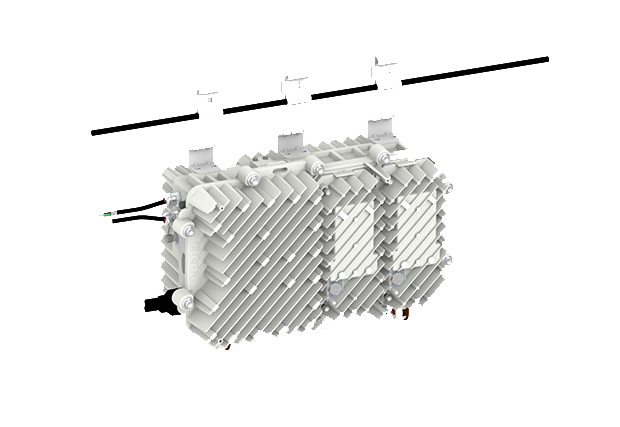
The ruggedized and hardened weatherproof 5131 Router is purpose-built to address the needs of multiple system operators (MSOs), mobile network operators (MNOs), and wholesalers to expand in the most challenging outdoor and uncontrolled environments, where traditional cabinets and shelters are impractical or too expensive.
There is a growing demand for more capacity in urban locations, alongside rapid expansion of the edge network into new rural territories, to meet increasing demands and deliver new applications. As the edge network advances, the right hub site might not exist. Moreover, there are challenges associated with rolling out new hubs on a vast scale, such as varying mechanical installations, regulatory concerns, mounting rights, and the desire for unobtrusive aesthetics.
Supporting high-density 1/10/25GbE access with 100GbE aggregation, the 5131 enables you to extend enterprise, mobile, wholesale, and broadband services deeper into the network edge without compromising performance, reliability, or service isolation.
Engineered for direct outdoor installation, the 5131 accelerates deployment by reducing permitting complexity, eliminating cabinet requirements, and enabling flexible mounting on poles, strands, walls, or H-frames. With redundant, field-replaceable AC, DC, or cable AC power options and compliance with GR-3108 Class 4 for outside plant environments, the 5131 delivers carrier-grade routing to hard-to-provision places.
Features and benefits
- Weatherproof, environmentally hardened enclosure for direct outdoor deployment (GR-3108 Class 4)
- Flexible mounting options including pole, strand, wall, and H-frame
- 12 x 1/10/25GbE and 2 x 100GbE ports
- Carrier Ethernet, IP routing, SR-MPLS, and SRv6 ready
- L1/L2/L3 low-latency switching
- Service isolation using FlexE
- Routing and switching OAM scaled to deliver 100GbE services with guaranteed SLA differentiation
- SZTP for rapid, error-free service turn-up
- Advanced synchronization with an integrated GNSS receiver
- SDN-ready management with NETCONF/YANG and gNMI/gRPC support
- Integration with Ciena’s Navigator Network Control Suite™ for multi-layer management and control
- Redundant, hot-swappable AC, DC, or cable AC power modules
Product overview
The 5131 is a compact yet powerful outdoor router designed to bring high-capacity aggregation and service demarcation closer to end users. With 12 x 1/10/25GbE SFP28 ports and 2 x 100GbE uplinks, the router supports dense access aggregation and high-speed transport in a single hardened enclosure. Its support for FlexE and segment routing (SR) enables both hard and soft network slicing, allowing you to safely converge multiple services, such as mobile fronthaul, enterprise Ethernet, and residential broadband, on shared infrastructure.
Unlike traditional access routers that rely on cabinets or controlled environments, the 5131 is purpose-built for direct exposure to outdoor conditions. Its sealed, temperature-controlled design protects against dust, rain, wind, and solar load, while assuring performance across a wide range of operating temperatures. This durability makes the 5131 an ideal router for rural expansion, urban densification, and distributed edge architectures.
Powered by SAOS
The 5131 is powered by Ciena’s Service-Aware Operating System (SAOS), a secure, carrier-grade operating system used across Ciena’s routing and switching platforms. SAOS delivers a consistent operational experience with service awareness, precise timing, QoS, advanced OAM, and secure zero-touch provisioning (SZTP).
Ciena’s Node Essentials capabilities are supported on the 5131, simplifying configuration through an intuitive GUI that replaces complex CLI workflows with guided provisioning.
Coherent and access capabilities
The 5131 supports coherent pluggable optics on its 100GbE interfaces, enabling high-capacity transport over extended distances without external optical shelves. For access, the 1/10/25GbE ports support Enhanced Common Public Radio Interface (eCPRI) and micro OLT (uOLT) pluggables, allowing a single router to deliver mobile fronthaul, Ethernet aggregation, and PON-based services. This convergence removes the need for multiple equipment, reducing site complexity and enabling you to maximize the value of each deployed node.
Applications
With flexible 1/10/25GbE access and integrated 100GbE uplinks, the 5131 enables compact, hardened deployment of Ethernet, IP, and VPN services at the access and metro edge.
- Ethernet service demarcation delivers MEF-aligned Carrier Ethernet with integrated IEEE 802.1ag, ITU-T Y.1731, RFC 2544, and ITU-T Y.1564 service activation testing. This demarcation enables rapid turn-up and SLA validation in the outside plant with no cabinets, reducing costs, permitting, and complexity
- Business and wholesale metro Ethernet supports EVPN-based virtual private wire service (VPWS), virtual private LAN service (VPLS), flexible cross-connect (FXC), and e-Tree services, providing flexible Layer 2 (L2) service delivery with clear user network interface (UNI) demarcation and comprehensive OAM
- Access and metro aggregation consolidates multiple 1/10/25GbE services onto 100GbE uplinks for transport into metro networks, supporting packet-based aggregation using multi-protocol label switching (MPLS), EVPN, and SR
- XGS-PON backhaul and aggregation supports transport of PON traffic from remote OLT (rOLT) or uOLT deployments, enabling converged fiber access architectures with efficient aggregation, service separation, and scalable delivery over shared Ethernet infrastructure
- IP networking enables L2VPN and Layer 3 (L3) VPN services using MPLS, EVPN, and SR to support IP and VPN deployments in enterprise and service provider environments
- Mobile transport and timing-aware networks support Synchronous Ethernet (SyncE) and IEEE 1588v2 timing for accurate frequency and phase synchronization in mobile backhaul and time-sensitive transport applications
Synchronization and timing
The 5131 is designed to meet the stringent timing requirements of modern mobile and time-sensitive applications. Integrated GNSS, SyncE, and IEEE 1588v2 support across all Ethernet ports enable precise frequency and phase delivery at the network edge. Assisted full timing support (AFTS) allows the network to maintain accurate timing even during GNSS impairments, improving resilience in dense 5G deployments and outdoor installations.
FlexE support further enhances timing performance by enabling deterministic transport of synchronization traffic alongside other services on shared high-speed links.
Security
The 5131 offers robust hardware and software security features designed for unattended outdoor deployments. Secure boot ensures the system runs only trusted software, while SZTP enables encrypted, authenticated onboarding from the first power-up. Role-based access control (RBAC) and hardware-assisted protection mechanisms help safeguard services and infrastructure against unauthorized access and attacks.
Sustainability
By enabling direct outdoor deployment and eliminating the need for cabinets, shelters, and additional cooling infrastructure, the 5131 significantly reduces material usage, power consumption, and site complexity. The 5131 is compliant with RoHS and WEEE directives and is designed to support long operational lifecycles, helping you build more sustainable and cost-efficient edge networks.
Technical specifications
| Specification | Description |
|---|---|
| Switching capacity | 360 Gb/s |
| CPU | 4 core ARM processor |
| Ports | 12 x 1/10/25GbE SFP28 ports 2 x 100GbE QSFP28/QSFP-DD ports OIF FlexE Implementation Agreement v1.1 and v2.0 PON SFP+ support eCPRI supported on 1/10/25GbE ports |
| Management ports | 1 x USB-A console 1 x USB-A console 1 x RJ45 management (MGMT) 1 x SMB/TNC GNSS antenna |
| Timing and synchronization | Synchronous Ethernet (SyncE) IEEE 1588v2 PTP Integrated GNSS receiver ITU-T G.8262 and G.8264 Enhanced SyncE EEC option 1 and 2 ITU-T G.8275.1 T-GM, T-BC, T-TSC with AFTS ITU-T G.8275.2 T-GM ITU-T G.8273.2 T-BC Class C T-BC/T-TSC ITU-T G.8272 Class A T-GM Stratum 3E oscillator |
| Security | Broadcast containment egress port restriction Hardware-based DoS attack prevention (L2, L3, L4) User access rights local user authorization Secure boot SZTP |
| Power supply options | Two redundant, hot-swappable power supplies (1 + 1 configuration) Dual AC Dual DC Cable AC power |
| Power requirements | DC input: -48 VDC (nominal) AC input: 100 VAC to 240 VAC CATV power unit rating range: 60 VAC to 90 VAC, 50/60 Hz Consumption: 90 W to 130 W (without optics) ETSI EN 300 132-2 ETSI EN 300 132-3 |
| Cooling | Fanless, passive cooling |
| Dimensions | Width: 432 mm (17 in.) Depth: 277 mm (11 in.) Height: 191 mm (7.5 in.) |
| Physical characteristics | 39.68 lb.; 18 kg |
| Operating temperature | -40°F to +115°F (-40°C to +46°C) with solar load -40°F to +140°F (-40°C to +60°C) |
| Storage temperature | -40°F to +158°F (-40°C to +70°C) |
| Humidity | 5% to 100% |
Maximum port density
| Specification | Description |
|---|---|
| 1GbE | 12 SFP28 ports |
| 10GbE | 12 SFP28 ports |
| 25GbE | 12 SFP28 ports |
| 100GbE | 2 QSFP28 / QSFP-DD ports |
Regulatory and standards compliance
| Specification | Description |
|---|---|
| Agency marks | CE (Europe) NRTL (NA) RCM (Australia and New Zealand) UKCA (UK) KCC (Korea) |
| Emissions and immunity (EMC) | CISPR 32 Class B EN 300 386 EN 55032 Class B AS/NZS CISPR 32 Class B BS EN 55032 Class B FCC Part 15 Subpart B, Class B ICES003 Class B VCCI CISPR 32 Class B GR-1089-CORE CISPR 35 EN 55035 BS EN 55035 QCVN 118:2018/BTTTT Class B KS C 9832 KS C 9835 KS X 3124 CNS 15936 Class A EN 301 489-1 EN 301 489-19 EN 303 413 |
| Network Equipment-Building System (NEBS) | GR-1089-CORE GR-3108-CORE GR-950-CORE GR-487-CORE |
| Environmental | RoHS Directive 2011/65/EU and 2015/863 WEEE 2012/19/EU |
| Environmental safety | ETSI 300 019 |
| Safety | EN 62368-1 UL62368-1 CSA C22.2 No. 62368-1 IEC 62368-1 |
Software features
Manageability
-
Authentication, authorization, and accounting (AAA)
- TACACS+ support
- DNS support
- CLI/NETCONF restore of saved configs and certificates
- Local accounting
- Local user authorization (RBAC)
- Local user management and authentication
- RADIUS support
- SSHv6 support
- Support for L3 in-band management
- AAA password aging and formatting
- Dynamic NACM
- Ability to limit local accounts NBI sessions per account type or organization
-
gRPC Network Management Interface (gNMI)
- Google remote procedure call (gRPC) dial-out support
- gNMI capabilities RPC support
- gNMI/gRPC telemetry support
-
L2 manageability
- Dynamic enable/disable FP stats
- L2 in-band management
- LLDP support
- Port-flap hold-down support
-
L3 manageability
- NTP support
- Management VRF support
-
Management
- IPv4 management
- IPv6 management
-
Reset, migration, and upgrades
- Reset to factory default (RTFD)
- RTUC (backup/restore)
- Upgrade/install from a single package file
-
Mirroring
- Port mirroring
-
NETCONF
- NETCONF access control support
- NETCONF/YANG support
- Transactional config support (phased-in)
- Candidate datastore capabilities
- <edit-config> replace support
-
CLI
- Display active configurations via CLI in XML format
-
Simple Network Management Protocol (SNMP)
- SNMP get
- SNMPv3
- SNMP traps
-
Syslog
- Syslog support
- Syslog remote support
- Syslog TLS support
- External event notification and alarm generation
- System, platform, and equipment management via syslog
-
ZTP/licensing
- ZTP support
- ZTP/v6 support
- SZTP support
- RFC 8572-compliant SZTP
-
Path Computation Element Protocol (PCEP)
- PCEP PCC-delegated
-
Border Gateway Protocol-Link State (BGP-LS)
- BGP-LS SR-MPLS
- TE metric values in BGP-LS
Security
-
System security
- 802.1X
- RADIUS for AAA
- Software signature validation
- Dynamic NACM
- OCSP
- TLSv1.3 support
-
Network security
- BGP MD5 authentication
-
Management
- SCP
- SSHv2
- Enrollment over security transport (EST) (RFC7030)
-
Access control list (ACL)
- IP ACL
-
Security certifications
- JITIC ASLAN L2
QoS
-
General QoS
- Egress QoS (scheduling/queuing/shaping)
- Hierarchical egress QoS (HEQoS)
- Ingress QoS (metering)
- WRED
- Large flow detection
- Large flow policing
- DSCP remarking
-
Hierarchical ingress metering
- CoS child meters and VLAN parent meter
- VLAN child meters and VLAN bundle parent meter
-
CoS mapping (RCOS)
- Classification on P-bit marking
- Classification on DSCP, MPLS-TC marking
Multicast
-
L2 multicast
- IGMPv3 snooping
-
L3 multicast
- IGMPv3
- IGMPv3 (PE-CE)
- PIM-SSM
- PIM-SSM (PE-CE)
- NG-MVPN
- NG-MVPN I-PMSI
- mLDP
- mLDP FRR
L2
-
Basic L2
- Basic MAC learning
- Ethernet bridging
- 802.1X
- QinQ
- CVID bundling
- Virtual MAC
- 9800B Port MTU
- 4 x 25GE breakout on 100GE ports
- 4 x 10GE breakout on 100GE ports
- Port holdover / carrier delay
- Link flap dampening exponential back-off
-
Flexible Ethernet
- FlexE
- L2-mapped FlexE with packet processing
- FlexE native protection
-
Link aggregation group (LAG) / multi-chassis (MC-LAG)
- LAG
- FAT PW
- LAG micro-BFD support
- ICCP MC-LAG (active/standby)
- ICCP MC-LAG (active/active) triangle topology
- Speculative hash
-
L2 Control Protocol (L2CP)
- L2CP handling (tunnel/forward/drop/peer)
- LLDP on OOB
- Per FP LLDP
-
L2 multicast
- IGMP snooping
-
Mirroring
- Port mirroring
-
Spanning tree protocols
- RSTP
-
MEF certification
- MEF 3.0 compliance
L3
-
General L3
- Route-map support
- RT-constraint
- MD5 authentication
- IP unnumbered
- IPv6 BFD
- Latency propagation via IGP
- Multinet support on IP interface
- Gratuitous ARP (GARP)
- Dynamic Address Resolution Protocol (ARP) inspection (DAI)
- Dynamic Host Configuration Protocol (DHCP) snooping
- IP source guard (IPSG)
- uRPF and uRPFv6
-
Equal-cost multi path routing (ECMP)
- IP ECMP
-
BGP
- iBGP
- eBGP
- MP-BGP
- Inter-AS option A
- Inter-AS option B
- Inter-AS option C
- BGP inline RR
- BGP PIC edge
- IPv6 BGP
- BGP large communities (RFC 8092)
- BGP dynamic update group
- BGP site of origin
- AIGP
- BGP policy for EVPN inbound and outbound RT filtering
- Configurable IPv6 link local address
- Add-path diverse support
- Remotely triggered black hole (RTBH) filtering
-
Intermediate System to Intermediate System (IS-IS)
- IS-IS for IPv4
- IS-IS level 1 and level 2
- IS-IS for IPv6
- ISIS TI-LFA
- IS-IS single-topology and multi-topology (IPv4/IPv6)
- IS-IS multi-instance (default vrf)
- IS-IS latency propagation
- IS-IS unreachable prefix announcement (UPA)
-
Open Shortest Path First (OSPF)
- OSPFv2
- OSPF TI-LFA
- OSPFv2 PE-CE RFC4577
- OSPFv2 multi-area adjacency
- OSPF keychain authentication
-
Graceful restart
- OSPF graceful restart helper
- ISIS graceful restart helper
- BGP graceful restart helper
- LDP graceful restart helper
- Target LDP graceful restart helper (PW FEC)
- OSPF graceful restart
- ISIS graceful restart (without SR GR support)
- ISIS graceful restart (SR-MPLS GR support)
- ISIS graceful restart (SRv6 GR support)
- BGP graceful restart
- LDP graceful restart
- Target LDP graceful restart
OAM
-
Connectivity Fault Management (CFM)
- CFM
- CFM (MEP)
- CFM (MIP)
- CFM linktrace
- CFM loopback
-
Link
- EFM OAM (802.3ah)
- EFM remote loopback
- Ethernet port loopback (ETTP)
-
Y.1731
- Y.1731
- Delay measurement
- Synthetic loss measurement
- MEF 35.1
-
Bidirectional Forwarding Detection (BFD)
- IPv4 single-hop BFD
- IPv6 single-hop BFD
- IPv4 multi-hop BFD
- MPLS-TP LSP BFD
- Micro BFD
-
Ping
- Ping
-
Traceroute
- Traceroute
-
TWAMP
- TWAMPv4 reflector
- TWAMPv6 reflector
- TWAMPv4 light
- TWAMPv6 light
-
2544 (SAT)
- RFC 2544 service activation testing
-
Y.1564 (SAT)
- Y.1564 service activation testing
Transport
-
General transport
- Latency flooding in IGP
- Latency flooding IGP-BGP-LS
- BGP-SR
- MPLS over LAG
-
SR-MPLS
- Anycast SID support for SR-MPLS
- Configurable SRGB
- IS-IS w/ SR extensions
- OSPF w/SR extensions with TI-LFA
- SR adjacency segment
- SR node segment
- SR MPLS TI-LFA
- uLoop avoidance TI-LFA (Bashandy)
- uLoop avoidance TI-LFA (ship to PLR)
- SR over Flex-E
- Flex-Algo (ISIS only ) single level
- TI-LFA with Flex Algo
- Flex Algo OAM (ping/tracert)
- SR stats (prefix SID, adj SID, anycast SID)
- Configurable/persistent ADJ-SID
- Hitless reversion
-
SRv6 uSID
- Basic feature support
- Flex Algo uSID
- SRv6 over FlexE
- TI-LFA
- TI-LFA uLoop avoidance
- SRv6 OAM (ping )
- SRv6 OAM (tracert)
- ISISv6
- SRv6 uSID stats
- L3VPN over SRv6 (IGP default)
- EVPN-VPWS over SRv6 (IGP default)
- EVPN-RT5 over SRv6 (IGP default)
- EVPN-VPLS/IRB over SRv6 (IGP default)
- EVPN-VPWS without IGP (single connect)
- L3VPN without IGP (single connect)
- Configurable/persistent link local
- Multi-instance support for SRv6
-
SRv6 uncompressed SID
- Basic feature support
- SRv6 over FlexE
- TI-LFA
- TI-LFA uLoop avoidance
- SRv6 OAM (ping )
- SRv6 OAM (tracert)
- ISISv6
- SRv6 uncompressed stats
- L3VPN over SRv6 (IGP default)
- EVPN-VPLS/ IRB over SRv6 (IGP default)
- EVPN-VPWS over SRv6 (IGP default)
- EVPN-RT5 over SRv6 (IGP default)
- Multi-instance support for SRv6
-
BGP Labeled Unicast (BGP-LU)
- BGP LU
-
Label Distribution Protocol (LDP)
- LDP
- LDP FRR/rLFA with IS-IS
- LDP FRR/rLFA with OSPF
- LDP-IGP sync
- uLoop avoidance LDP-FRR
- LDP stats (decap/encap/transit)
-
MPLS-Transport Profile (MPLS-TP)
- MPLS-TP static
- MPLS-TP static (LSR)
- MPLS-TP transit stats
- MPLS-TP stats (decap/encap/transit)
-
Resource Reservation Protocol-Traffic Engineering (RSVP-TE)
- ISIS RSVP-TE support for L1
- ISIS RSVP-TE support for L2
- RSVP-TE over LAG interface
- RSVP-TE LSP ping and LSP traceroute
- GR helper mode
- GR restarting node
- RSVP-TE statistics and counters
- CSPF ISIS L1
- Affinity include-any, include-all, exclude-any
- TE parameters LSP autosizing (autobandwidth)
- Autosizing utilization-based LSP autobandwidth
- Autosizing upsize or downsize on basis of TCA
- Autosizing oversubscription
- Periodic reoptimization
- MBB (make-before-break) at the ingress LER
- Soft preemption and hard preemption with configurable setup and hold priorities
- Soft preemption non-Ciena interop
- RSVP-FRR link and node protect
- Auto-FB profile
- Shared risk link group (SRLG)-aware FB
- BGP-LU over RSVP-TE (FRR protected tunnel only)
- Services L2 PWs (tLDP) over RSVP-TE
- RSVP-TE CSPF command to run CSPF on specified set of TE constraints to a given destination without signaling the LSP
- RSVP-TE CSPF, ISIS L1 Router with P2P L1 Adj
- RSVP-TE transit tunnel stats
- Configure color on RSVP tunnels
-
SR policy (SR-MPLSv4)
- SR policy for SR-MPLSv4
- Hardware-programmed backup path
- Seamless-BFD (IP return)
- Seamless-BFD (Label return path)
- Automated next-hop resolution ANR
- ANR with SR policy (primary CP only)
- SR policy stats
-
SR policy (SRv6)
- SR-policy for SRv6 (with 1 CP)
- SRv6 policy stats
-
Service over SR policy (SR-MPLSv4)
- EVPN (VPWS) over SR policy
- L3VPN (v4/v6) over SR policy
- EVPN Type 5 (v4/V6) over SR policy
- L2VPN over SR policy (VPWS and VPLS)
- EVPN VPLS over SR policy
-
Service over SR policy (SRv6)
- EVPN VPWS SR policy
- L3VPN over SR policy
- EVPN Type 5 (v4/V6) over SR policy
- EVPN VPLS/IRB over SR policy
-
Interworking
- SR to LDP mapping server
- SR to BGP-LU mapping server
- MPLS-TP to SR interworking (MS-PW)
-
SRLG
- SRLG per port-based assignment
- SRLG info propagation via IGP
-
Transport tunnel select
- SR policy with fallback option (SR-BE)
- Global selection knob between LDP and SR
-
SR performance management (SR-PM)
- via Y.1731
- via TWAMPv4 lite
- for SR-MPLSv4 (SR policy)
- for SRv6 (SR policy)
- for SRv6 (Flex Algo)
-
G.8032
- Major rings
- Subrings and ring interconnections
- Interworking MC-LAG
- Fast convergence
Synchronization and timing
-
General timing
- SyncE
- G.8275.1 T-BC
- G.8275.1 T-TSC
- G.8275.1 T-GM
- Integrated GNSS receiver
- G.8275.2 T-GM
- 1 PPS output
- 10 MHz input
- GNSS-based location
Services
-
EVPN
- EVPN FXC (single-homing)
- EVPN FXC (multi-homing, active-standby, local switching)
- EVPN VPWS (single-homing)
- EVPN VPWS multi-homing (all-active, local PE)
- EVPN VPWS multi-homing (all-active, remote PE)
- EVPN FXC multi-homing (all-active, local PE)
- EVPN FXC multi-homing (all-active, remote PE)
- Single-active EVLAG (port-active multi-homing)
- EVPN VPLS (single-homing)
- EVPN VPLS (all-active, multi-homing)
- EVPN IRB
- EVPN RT5 routes (L3VPN support with EVPN)
- eVPN e-Tree RFC 8317 scenario 1
- EVPN e-Tree (all-active multi-homing root)
-
L2VPN
- Static VPWS
- VPWS
- VPLS
- VPLS BGP-AD
- FAT PW
- MS-PW
- L2VPN VPLS MAC with draw/MAC flush
- H-VPLS
- H-VPLS protection
- PW over protected SR-TE and TI-LFA
- T-LDP graceful restart helper
- L2VPN e-Tree
-
L3VPN
- L3VPN
- VRF-Lite
- L3VPN QoS
- 6VPE
- 6PE
- VPN4 default-info originate
- Default originate for VRF
- VPNv4 PIC edge
- 6VPE PIC edge
- VRF traceroute (no transit)
- NG MVPN
- IRB
- BGP route aggregation in a VRF
-
DHCP
- DHCPv4 L3 relay in VRF
- DHCPv6 L3 relay in VRF
- DHCPv4 (RFC 2132)
- DHCPv4 L3 relay agent
- DHCPv6 client for MGMT interface
- DHCPv6 L3 relay agent
Ordering information (SAOS 10.x)
| Part number | Description |
|---|---|
| 170-5131-900 | 5131, (12)25/10/1G SFP28,(2)100G QSFP28, EXT. TEMP,(2) SLOTS AC OR DC PLUG POWER SUPPLY |
| 170-0357-900 | 5131, DC PLUGGABLE POWER SUPPLY 48V |
| 170-0358-900 | 5131, AC PLUGGABLE POWER SUPPLY, WIDE RANGE 120/240V |
| 170-0359-900 | 5131, CABLE AC PLUGGABLE POWER SUPPLY |
| 170-0360-900 | 5131, POWER FILLER MODULE |
| 170-0361-900 | 5131, FIBER CABLE KIT |
| 170-0362-900 | 5131, AC POWER CABLE KIT |
| 170-0363-900 | 5131, POLEMOUNT KIT |
| 170-0364-900 | 5131, STRANDMOUNT KIT |
| 170-0395-900 | 5131, WALL MOUNT |
| 170-0396-900 | 5131, H-FRAME MOUNT |
| 170-0397-900 | 5131, SQUARE POLE MOUNT |
| 170-0375-900 | 5131 DC POWER CABLE KIT |
| 170-0376-900 | 5131 CATV POWER CABLE KIT |
| Required OS base system perpetual software licenses | |
| S75-LIC-5131EO-P | SAOS BASE OS, ETHERNET & OAM, FLEXE, SOFTWARE LICENSE FOR 5131, PERPETUAL |
| Optional OS applications | |
| S75-LIC-5131MPLS-P | SAOS ROUTING AND MPLS SOFTWARE LICENSE FOR 5131, PERPETUAL |
| S75-LIC-5131SYNC-P | SAOS SYNCHRONIZATION SOFTWARE LICENSE FOR 5131, PERPETUAL |
| S75-LIC-5131SEC-P | SAOS SECURITY SOFTWARE LICENSE FOR 5131, PERPETUAL |
| S75-LIC-5131100G-P | SAOS 100G SOFTWARE LICENSE FOR 5131, PERPETUAL |
| S75-LIC-5131EVPN-P | SAOS EVPN SOFTWARE LICENSE FOR 5131, PERPETUAL |
Ciena may make changes at any time to the products or specifications contained herein without notice. Ciena and the Ciena Logo are trademarks or registered trademarks of Ciena Corporation in the U.S. and other countries. A complete list of Ciena’s trademarks is available at www.ciena.com. Third-party trademarks are the property of their respective owners and do not imply a partnership between Ciena and any other company.