




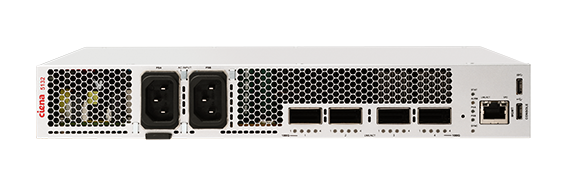
Designed for high-capacity service demarcation and aggregation at the network edge, the 5132 Platform is a compact, temperature-hardened 360 Gb/s router optimized for 100GbE business, wholesale, mobile, and cloud connectivity. Purpose-built to deliver deterministic performance and strong service isolation, the 5132 enables you to converge multiple services—enterprise Ethernet, mobile xHaul, and cloud on-ramp—on a single, space-efficient platform.
With support for WaveLogic™ 5 Nano (WL5n) coherent optics, FlexE, and segment routing (SR), the 5132 brings scalable 100GbE services closer to the edge while simplifying operations and accelerating service activation in space- and power-constrained environments.
Features and benefits
- Temperature-hardened operation (-40°C to +65°C) for edge and outside-plant deployments
- Compact 1 RU, shallow-depth, fixed form factor for space-constrained locations
- 360 Gb/s switching capacity optimized for 100GbE service delivery
- 2 x 100GbE QSFP28 and 2 x 100GbE QSFP-DD fixed ports
- Support for coherent WL5n optics on QSFP-DD ports
- L1/L2/L3 low-latency switching
- Service isolation using FlexE
- Carrier Ethernet, IP routing, SR-MPLS, and SRv6 ready
- Hardware-assisted packet OAM for guaranteed SLA differentiation
- Built-in RFC 2544 and ITU-T Y.1564 service activation testing at 100 Gb/s
- SZTP for rapid, error-free service turn-up
- Advanced synchronization with SyncE and IEEE 1588v2 on all ports
- SDN-ready management with NETCONF/YANG and gNMI/gRPC support
- Integration with Ciena’s Navigator NCS for multi-layer management and control
- Redundant AC or DC power options
Product overview
The 5132 is a hardened, dual-redundant-powered 1 RU router delivering 360 Gb/s of switching capacity in a shallow-depth, fixed form factor. It features a combination of 100GbE QSFP28 and QSFP-DD ports, enabling both grey and coherent pluggable optics for flexible UNI and NNI deployments.
Supporting low-latency Layer 1, Layer 2, and Layer 3 (L1/L2/L3) switching, Carrier Ethernet, IP routing, SR-MPLS, and SRv6, the 5132 is designed for service demarcation and aggregation at the enterprise edge, cell sites, aggregation hubs, and cloud access locations. Hard network slicing using FlexE and soft slicing using SR ensure deterministic performance and traffic isolation across converged services.
When paired with Ciena’s Navigator Network Control Suite™ (Navigator NCS), the 5132 delivers end-to-end visibility, automation, and control across packet and optical layers—making it a foundational platform for scalable, future-ready edge networks.
Powered by SAOS
The 5132 is powered by Ciena’s Service-Aware Operating System (SAOS), a secure, carrier-grade operating system used across Ciena’s routing and switching portfolio. SAOS delivers a consistent operational experience with service awareness, precise timing, QoS, advanced OAM, and secure zero-touch provisioning (SZTP).
Ciena’s Node Essentials capabilities are supported on the 5132, simplifying configuration through an intuitive GUI that replaces complex CLI workflows with guided, form-based provisioning.
Applications
With high-capacity 100GbE interfaces and integrated service assurance, the 5132 enables flexible deployment of Ethernet services across business, wholesale, and time-sensitive transport networks at the access and metro edge.
- 100GbE service demarcation delivers high-capacity Ethernet demarcation with integrated RFC 2544 and ITU-T Y.1564 service activation testing, enabling rapid turn-up and SLA validation without external test equipment
- Business and wholesale metro Ethernet provides MEF-aligned Carrier Ethernet services, including E-Line, E-LAN, E-Tree, and E-Access, with clear UNI and NNI demarcation and hardware-assisted OAM
- Metro and service aggregation aggregates multiple Ethernet services onto 100GbE uplinks for transport into metro networks, supporting packet switching and FlexE for bandwidth partitioning and service separation
- IP and VPN service delivery at the edge supports IP routing, MPLS, SR, and EVPN-based L2VPN and L3VPN services in access and metro environments
- Timing-aware transport networks support Synchronous Ethernet (SyncE) and IEEE 1588v2, enabling accurate frequency and phase synchronization for time-sensitive applications, including mobile transport environments
Software-defined networking and automation
The 5132 supports a standards-based, model-driven management approach using YANG data models. It offers multiple management interfaces, including NETCONF, Google remote procedure call (gRPC) / gRPC Network Management Interface (gNMI) streaming telemetry, and CLI.
Advanced transactionality enables seamless handling of complex configuration changes. When integrated with Navigator NCS, the 5132 enables multi-layer software-defined networking (SDN) automation and control across IP and optical domains.
Security
The 5132 incorporates robust hardware and software security features, including secure boot to ensure only trusted SAOS software is executed. SZTP enables encrypted, authenticated onboarding from first power-up, reducing operational risk and deployment time.
Sustainability
Designed for long operational lifecycles, the 5132 meets RoHS and WEEE environmental standards. Its compact footprint and power-efficient design help you reduce space, power, and cooling requirements while supporting sustainable network growth.
Technical specifications
| Specification | Description |
|---|---|
| Switching capacity | 360 Gb/s |
| Ports | 2 x 100GbE QSFP28 (FlexE capable) 2 x 100GbE QSFP-DD OIF FlexE Implementation Agreement v1.1 and v2.0 |
| Management ports | 1 x USB (storage) 1 x USB-C console 1 x RJ45 management (MGMT) |
| Timing and synchronization | SyncE IEEE 1588v2 PTP Assisted full timing support (AFTS) ITU-T G.8262, G.8262.1, G.8263, G.8264 ITU-T G.8275.1 (T-GM, T-BC, T-TSC) ITU-T G.8271 Class A T-GM ITU-T G.8273.2 T-BC Class C |
| Security | Secure boot SZTP |
| Power supply options | Dual power supply 200W DC/AC (front access) |
| Power requirements | Power (AC): 100 V to 240 V, IEC C14 connector Power (DC): -48 VDC (nominal), 36 V to to 60 VDC, DC inlet with radio frequency interference (RFI) line filter connector Typical power: 85 W Maximum power: 125 W ETSI EN 300 132-2 ETSI EN 300 132-3 |
| Cooling | Five redundant fans, factory populated No impact to operation upon single fan failure. |
| Dimensions | Width: 293 mm (11.54 in.) Depth: 253 mm (9.96 in.) Height: 44 mm (1.73 in.) |
| Physical characteristics | 7.5 lb.; 3.4 kg |
| Operating temperature | –40°F to +149°F (–40°C to +65°C) |
| Storage temperature | -40°F to +158°F (-40°C to +70°C) |
| Humidity | Noncondensing, 5% to 90% |
Maximum port density
| Specification | Description |
|---|---|
| 100GbE | 4 QSFP28 / QSFP-DD ports |
Regulatory and standards compliance
| Specification | Description |
|---|---|
| Emissions and immunity (EMC) | CISPR 32 Class A EN 55032 FCC Part 15 Class A ICES-003 Class A VCCI CISPR 32 Class A GR-1089-CORE CISPR 35 EN 5505 EN 300 386 TEC/SD/DD/EMC-221/05/OCT-16 |
| Network Equipment-Building System (NEBS) | GR-63-CORE |
| Environmental | RoHS Directive 2011/65/EU and 2015/863 WEEE 2012/19/EU |
| Safety | EN 62368-1 IEC 62368-1 UL 62368-1 CSA C22.2 No. 62368-1 |
Software features
Manageability
-
Authentication, authorization, and accounting (AAA)
- TACACS+ support
- DNS support
- CLI/NETCONF restore of saved configs and certificates
- Local accounting
- Local user authorization (role-based access control [RBAC])
- Local user management and authentication
- RADIUS support
- SSHv6 support
- Support for L3 in-band management
- AAA password aging and formatting
- Dynamic NACM
- Ability to limit local accounts NBI sessions per account type or organization
-
gNMI
- gRPC dial-out support
- gNMI capabilities RPC support
- gNMI/gRPC telemetry support
-
L2 manageability
- Dynamic enable/disable FP stats
- L2 in-band management
- LLDP support
- Port-flap hold down support
-
L3 manageability
- NTP support
- Management VRF support
-
Management
- IPv4 management
- IPv6 management
-
Reset, migration, and upgrades
- Reset to factory default (RTFD)
- RTUC (backup/restore)
- Upgrade/install from a single package file
-
Mirroring
- Port mirroring
-
NETCONF
- NETCONF access control support
- NETCONF/YANG support
- Transactional config support
- Candidate datastore capabilities
- <edit-config>'s replace support
-
CLI
- Display active configurations via CLI in XML format
-
Simple Network Management Protocol (SNMP)
- SNMP get
- SNMPv3
- SNMP traps
-
Syslog
- Syslog support
- Syslog remote support
- Syslog TLS support
- External event notification and alarm generation
- System, platform, and equipment management via syslog
-
ZTP/licensing
- ZTP support
- ZTP/v6 support
- SZTP support
- RFC 8572-compliant SZTP
-
Path Computation Element Protocol (PCEP)
- PCEP PCC-delegated
-
Border Gateway Protocol (BGP-LS
- BGP-LS SR-MPLS
- TE metric values in BGP-LS
Security
-
System security
- 802.1X
- RADIUS for AAA
- Software signature validation
- Dynamic NACM
- OCSP
- TLSv1.3 support
-
Network security
- BGP MD5 authentication
-
Management
- SCP
- SSHv2
- Enrollment over security transport (EST) (RFC7030)
-
Access control list (ACL)
- IP ACL
-
Security certifications
- JITIC ASLAN L2
QoS
-
General QoS
- Egress QoS (scheduling/queuing/shaping)
- Hierarchical egress QoS (HEQoS)
- Ingress QoS (metering)
- WRED
- Large flow detection
- Large flow policing
- DSCP remarking
-
Hierarchical ingress metering
- CoS child meters and VLAN parent meter
- VLAN child meters and VLAN bundle parent meter
-
CoS mapping (RCOS)
- Classification on P-bit marking
- Classification on DSCP, MPLS-TC marking
Multicast
-
L2 multicast
- IGMPv3 snooping
-
L3 multicast
- IGMPv3
- IGMPv3 (PE-CE)
- PIM-SSM
- PIM-SSM (PE-CE)
- NG-MVPN
- NG-MVPN I-PMSI
- mLDP
- mLDP FRR
OAM
-
TWAMP
- TWAMPv4 reflector
- TWAMPv6 reflector
- TWAMPv4 light
- TWAMPv6 light
-
2544 (SAT)
- RFC 2544 Service Activation Testing
-
Y.1564 (SAT)
- Y.1564 Service Activation Testing
L2
-
MEF certification
- MEF 3.0 compliance
-
TDM services
- TDM SFP
L3
-
General L3
- Route-map support
- RT-constraint
- MD5 authentication
- IP unnumbered
- IPv6 BFD
- Latency Propagation via IGP
- Multinet support on IP interface
- Gratuitous ARP (GARP)
- Dynamic Address Resolution Protocol (ARP) inspection (DAI)
- Dynamic Host Configuration Protocol (DHCP) snooping
- IP source guard (IPSG)
- uRPF and uRPFv6
- Configurable ARP/ND cache timeout
-
Equal-cost multi-path routing
- IP ECMP
-
BGP
- iBGP
- eBGP
- MP-BGP
- Inter-AS option A
- Inter-AS option B
- Inter-AS option C
- BGP inline RR
- BGP PIC edge
- IPv6 BGP
- BGP large communities (RFC 8092)
- BGP dynamic update group
- BGP site of origin
- AIGP
- BGP policy for EVPN inbound and outbound RT filtering
- Configurable IPv6 link local address
- Add-path diverse support
- Remotely triggered black hole (RTBH) filtering
-
Intermediate System to Intermediate System (IS-IS)
- IS-IS for IPv4
- IS-IS level 1 and level 2
- IS-IS for IPv6
- ISIS TI-LFA
- IS-IS Single-topology and multi-topology (IPv4/IPv6)
- IS-IS multi-instance (default vrf)
- IS-IS latency propagation
- IS-IS unreachable prefix announcement (UPA)
-
Open Shortest Path First (OSPF)
- OSPFv2
- OSPF TI-LFA
- OSPFv2 PE-CE - RFC4577
- OSPFv2 multi-area adjacency
- OSPF keychain authentication
-
Graceful restart
- OSPF graceful restart helper
- ISIS graceful restart helper
- BGP graceful restart helper
- LDP graceful restart helper
- Target LDP graceful restart helper (PW FEC)
- OSPF graceful restart
- ISIS graceful restart (without SR GR support)
- ISIS graceful restart (SR-MPLS GR support)
- ISIS graceful restart (SRv6 GR support)
- BGP graceful restart
- LDP graceful restart
- Target LDP graceful restart
Transport
-
General transport
- Latency flooding in IGP
- Latency flooding IGP-BGP-LS
- BGP-SR
- MPLS over LAG
-
SR-MPLS
- Anycast SID support for SR-MPLS
- Configurable SRGB
- IS-IS w/ SR extensions
- OSPF w/SR extensions with TI-LFA
- SR adjacency segment
- SR node segment
- SR MPLS TI-LFA
- uLoop avoidance TI-LFA (Bashandy)
- uLoop avoidance TI-LFA (Ship to PLR)
- SR over Flex-E
- Flex-Algo (ISIS only ) single level
- TI-LFA with FlexAlgo
- FlexAlgo OAM (ping/ tracert)
- SR stats (Prefix SID, Adj SID, Anycast SID)
- Configurable/persistent ADJ-SID
- Hitless reversion
-
SRv6 uSID
- Basic feature support
- FlexAlgo uSID
- SRv6 over FlexE
- TI-LFA
- TI-LFA uLoop avoidance
- SRv6 OAM (ping )
- SRv6 OAM (tracert)
- ISISv6
- SRv6 uSID stats
- L3VPN over SRv6 (IGP default)
- EVPN-VPWS over SRv6 (IGP default)
- EVPN-RT5 over SRv6 (IGP default)
- EVPN-VPLS/IRB over SRv6 (IGP default)
- EVPN-VPWS without IGP (single connect)
- L3VPN without IGP (single connect)
- Configurable/persistent link local
-
SRv6 uncompressed SID
- Basic feature support
- SRv6 over FlexE
- TI-LFA
- TI-LFA uLoop avoidance
- SRv6 OAM (ping )
- SRv6 OAM (tracert)
- ISISv6
- SRv6 uncompressed stats
- L3VPN over SRv6 (IGP default)
- EVPN-VPLS/ IRB over SRv6 (IGP default)
- EVPN-VPWS over SRv6 (IGP default)
- EVPN-RT5 over SRv6 (IGP default)
-
BGP Labeled Unicast (BGP-LU)
- BGP LU
-
Label Distribution Protocol (LDP)
- LDP
- LDP FRR/rLFA w/IS-IS
- LDP FRR/rLFA w/OSPF
- LDP-IGP sync
- uLoop avoidance LDP-FRR
- LDP stats (decap/encap/transit)
-
MPLS-Transport Profile (MPLS-TP)
- MPLS-TP static
- MPLS-TP static (LSR)
- MPLS-TP transit statistics
- MPLS-TP stats (decap/encap/transit)
-
Resource Reservation Protocol-Traffic Engineering (RSVP-TE)
- ISIS RSVP-TE support for L1
- ISIS RSVP-TE support for L2
- RSVP-TE over LAG interface
- RSVP-TE LSP ping and LSP traceroute
- GR helper mode
- GR restarting node
- RSVP-TE statistics and counters
- CSPF ISIS L1
- Affinity include-any, include-all, exclude-any
- TE parameters LSP auto-sizing (auto bandwidth)
- Auto-sizing utilization-based LSP auto-bandwidth
- Auto-sizing up-size or down-size on basis of TCA
- Auto-sizing oversubscription
- Periodic re-optimization
- MBB (make-before-break) at the ingress LER
- Soft preemption and hard preemption with configurable setup and hold priorities
- Soft preemption non-Ciena interop
- RSVP-FRR link and node protect
- Auto-FB profile
- Shared risk link group (SRLG) aware FB
- BGP-LU over RSVP-TE (FRR-protected tunnel only)
- Services L2 PWs (tLDP) over RSVP-TE
- RSVP-TE CSPF command to run CSPF on specified set of TE constraints to a given destination without signaling the LSP
- RSVP-TE CSPF ISIS L1 router with P2P L1 Adj
- RSVP-TE transit tunnel stats
- Configure color on RSVP tunnels
-
SR policy (SR-MPLSv4)
- SR policy for SR-MPLSv4
- Hardware-programmed backup path
- Seamless-BFD (IP return)
- Seamless-BFD (label return path)
- Automated next-hop resolution ANR
- ANR with SR policy (primary CP only)
- SR policy stats
-
SR policy (SRv6)
- SR policy for SRv6 (with 1CP)
- SRv6 policy stats
-
Service over SR policy (SR-MPLSv4)
- EVPN (VPWS) over SR policy
- L3VPN (v4/v6) over SR policy
- EVPN type 5 (v4/V6) over SR policy
- L2VPN over SR policy (VPWS and VPLS)
- EVPN -VPLS over SR policy
-
Service over SR policy (SRv6)
- EVPN-VPWS SR policy
- L3VPN over SR policy
- EVPN type 5 (v4/V6) over SR policy
- EVPN VPLS/IRB over SR policy
-
Interworking
- SR to LDP mapping server
- SR to BGP-LU mapping server
- MPLS-TP to SR interworking- (MS-PW)
-
SRLG
- SRLG per port based assignment
- SRLG info prorogation via IGP
-
Transport tunnel select
- SR policy with fallback option (SR-BE)
- Global selection knob between LDP and SR
-
SR-PM
- via Y.1731
- via TWAMPv4 lite
- for SR-MPLSv4 (SR policy)
- for SRv6 (SR policy)
- for SRv6 (Flex-Algo)
-
G.8032
- Major rings
- Sub-rings and ring interconnections
- Interworking MC-LAG
- Fast convergence
Synchronization and timing
-
General timing
- SyncE
- G.8275.1 T-BC
- G.8275.1 T-TSC
- G.8275.1 T-GM
- Integrated GNSS receiver
- G.8275.2 T-GM
- 1 PPS output
- 10Mhz input
- GNSS-based location
Services
-
EVPN
- EVPN FXC (single-homing)
- EVPN FXC (multi-homing active-standby, local switching)
- EVPN VPWS (single-homing)
- EVPN VPWS multi-homing (all-active, local PE)
- EVPN VPWS multi-homing (all-active, remote PE)
- EVPN FXC multi-homing (all-active, local PE)
- EVPN FXC multi-homing (all-active, remote PE)
- Single-active EVLAG (port-active multi-homing)
- EVPN VPLS (single-homing)
- EVPN VPLS (all-active multi-homing)
- EVPN IRB
- EVPN RT5 Routes (L3VPN support with EVPN)
- eVPN e-Tree RFC 8317 scenario 1
- EVPN e-Tree (all-active multi-homing root)
-
L2VPN
- Static VPWS
- VPWS
- VPLS
- VPLS BGP-AD
- FAT PW
- MS-PW
- L2VPN VPLS MAC with draw/MAC flush
- H-VPLS
- H-VPLS protection
- PW over protected SR-TE and TI-LFA
- T-LDP graceful restart helper
- L2VPN e-Tree
-
L3VPN
- L3VPN
- VRF-Lite
- L3VPN QoS
- 6VPE
- 6PE
- VPN4 default-info originate
- Default originate for VRF
- VPNv4 PIC edge
- 6VPE PIC edge
- VRF traceroute (No transit)
- NG MVPN
- IRB
- BGP route aggregation in a VRF
-
DHCP
- DHCPv4 L3 relay in VRF
- DHCPv6 L3 relay in VRF
- DHCPv4 (RFC 2132)
- DHCPv4 L3 relay agent
- DHCPv6 client for MGMT interface
- DHCPv6 L3 relay agent
Ordering information
| Part number | Description |
|---|---|
| 170-5132-900 | 5132,(2)100G QSFP28,(2)100G QSFP-DD,SYNC,EXT. TEMP,DUAL DC POWER |
| 170-5132-901 | 5132,(2)100G QSFP28,(2)100G QSFP-DD,SYNC,EXT. TEMP,DUAL AC POWER,REQ. POWER CABLE |
| Required OS base system perpetual software licenses | |
| S75-LIC-5132EO-P | SAOS BASE OS, ETHERNET & OAM SOFTWARE LICENSE FOR 5132, PERPETUAL |
| Optional OS applications | |
| S75-LIC-5132MPLS-P | SAOS ROUTING/MPLS SOFTWARE LICENSE FOR 5132, PERPETUAL |
| S75-LIC-5132SYNC-P | SAOS SYNCHRONIZATION SOFTWARE LICENSE FOR 5132, PERPETUAL |
| S75-LIC-5132SEC-P | SAOS SECURITY SOFTWARE LICENSE FOR 5132, PERPETUAL |
| S75-LIC-5132EVPN-P | SAOS EVPN SOFTWARE LICENSE FOR 5132, PERPETUAL |
Ciena may make changes at any time to the products or specifications contained herein without notice. Ciena and the Ciena Logo are trademarks or registered trademarks of Ciena Corporation in the U.S. and other countries. A complete list of Ciena’s trademarks is available at www.ciena.com. Third-party trademarks are the property of their respective owners and do not imply a partnership between Ciena and any other company.