



Video Length
Video
Understanding scale-up and scale-out networks
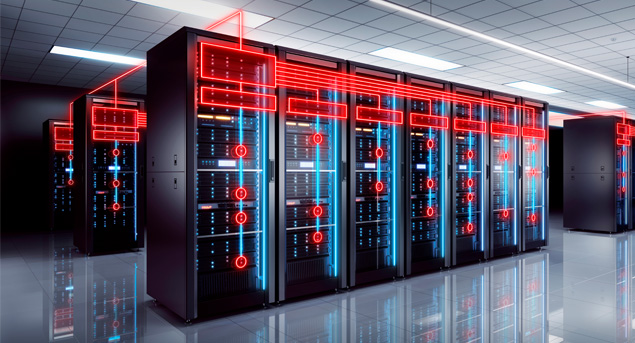
AI model training depends on dedicated networking architectures designed for different performance requirements. In this video, Spencer Giacalone, Senior Director of Cloud and AI Architecture, explains the roles of scale-up and scale-out networks, why both are essential for AI infrastructure, and how technologies such as NVLink, RoCEv2, and emerging standards enable efficient, high-performance AI networks. He also discusses how Ciena’s Nitro and Vesta products support next-generation XPU connectivity.
1
00:00:00,000 --> 00:00:01,680
Hi, I'm Spencer Giacalone,
2
00:00:01,680 --> 00:00:04,230
Principal CTO
Architect at Ciena.
3
00:00:04,230 --> 00:00:06,675
If you're interested
in AI infrastructure,
4
00:00:06,675 --> 00:00:09,210
you've probably heard of
scale-up and scale-out.
5
00:00:09,210 --> 00:00:11,655
But what are they, and
why do they exist?
6
00:00:11,655 --> 00:00:14,700
AI training involves
huge mathematical models
7
00:00:14,700 --> 00:00:16,305
and large amounts of data.
8
00:00:16,305 --> 00:00:18,165
To fit these into GPU memory,
9
00:00:18,165 --> 00:00:19,740
while minimizing training time,
10
00:00:19,740 --> 00:00:21,150
the model and data are
11
00:00:21,150 --> 00:00:23,370
split across sets of GPUs.
12
00:00:23,370 --> 00:00:25,020
But during training,
the model needs
13
00:00:25,020 --> 00:00:27,030
to be iteratively consolidated.
14
00:00:27,030 --> 00:00:29,340
And that imposes
various traffic flows on
15
00:00:29,340 --> 00:00:30,720
the network–each of which
16
00:00:30,720 --> 00:00:32,370
has different performance
requirements,
17
00:00:32,370 --> 00:00:35,220
but all of which are
intolerant to jitter and loss.
18
00:00:35,220 --> 00:00:37,800
Congestion or packet drops can
19
00:00:37,800 --> 00:00:40,905
cause training corruption,
stalls, or restarts.
20
00:00:40,905 --> 00:00:44,100
These training issues are
costly and time consuming,
21
00:00:44,100 --> 00:00:46,260
and so we place
training flows onto
22
00:00:46,260 --> 00:00:49,605
dedicated AI networks—scale-up
and scale-out.
23
00:00:49,605 --> 00:00:51,660
Scale-up and scale-out exist in
24
00:00:51,660 --> 00:00:54,915
AI clusters to protect training
flows with high capacity,
25
00:00:54,915 --> 00:00:57,780
low latency, lossless
network connectivity.
26
00:00:57,780 --> 00:00:59,370
Scale-up and scale-out have
27
00:00:59,370 --> 00:01:00,780
different performance and size
28
00:01:00,780 --> 00:01:03,810
characteristics—and they
use different technologies.
29
00:01:03,810 --> 00:01:07,720
Scale-up is the smaller but
high-capacity AI network.
30
00:01:07,720 --> 00:01:10,325
For example, in
NVIDIA's GB200 design,
31
00:01:10,325 --> 00:01:12,350
it provides 14.4T of
32
00:01:12,350 --> 00:01:16,280
capacity to each of 72
GPUs in a single rack.
33
00:01:16,280 --> 00:01:17,920
Larger, faster,
scale-up designs
34
00:01:17,920 --> 00:01:19,650
will be coming soon,
35
00:01:19,650 --> 00:01:21,990
and in some cases have
already been done.
36
00:01:21,990 --> 00:01:24,390
In NVIDIA's architecture,
scale-up uses
37
00:01:24,390 --> 00:01:27,570
the bookended, or
proprietary, NVLink protocol,
38
00:01:27,570 --> 00:01:29,580
which provides
integrated congestion
39
00:01:29,580 --> 00:01:32,160
and buffer management
at high speed.
40
00:01:32,160 --> 00:01:35,400
However, new standards
such as UALink and
41
00:01:35,400 --> 00:01:37,070
ESUN are being launched
42
00:01:37,070 --> 00:01:39,270
to open the
scale-up ecosystem.
43
00:01:39,270 --> 00:01:41,025
Scale-out, on the other hand,
44
00:01:41,025 --> 00:01:44,190
is the larger, but slower
dedicated AI network.
45
00:01:44,190 --> 00:01:46,860
Scale-out can support
hundreds of thousands
46
00:01:46,860 --> 00:01:48,735
of GPUs in a single campus,
47
00:01:48,735 --> 00:01:50,115
but at ethernet speeds.
48
00:01:50,115 --> 00:01:52,530
Most scale-out
networks run RDMA over
49
00:01:52,530 --> 00:01:55,650
converged Ethernet, or
RoCEv2, protocol, and that
50
00:01:55,650 --> 00:01:58,650
encapsulates the
InfiniBand transport layer
51
00:01:58,650 --> 00:02:00,135
in IP and Ethernet.
52
00:02:00,135 --> 00:02:02,400
To make ethernet
lossless for AI,
53
00:02:02,400 --> 00:02:04,560
features like Priority
Flow Control and
54
00:02:04,560 --> 00:02:06,600
Explicit Congestion
Notification are
55
00:02:06,600 --> 00:02:08,250
used to mitigate drops.
56
00:02:08,250 --> 00:02:11,070
As with scale-up, new
standards are evolving,
57
00:02:11,070 --> 00:02:12,765
with the most
notable being those
58
00:02:12,765 --> 00:02:14,665
from the Ultra
Ethernet Consortium.
59
00:02:14,665 --> 00:02:17,855
In summary, AI models
and data are very large.
60
00:02:17,855 --> 00:02:20,615
So, we split them up
across groups of GPUs.
61
00:02:20,615 --> 00:02:23,000
However, consolidation
is required
62
00:02:23,000 --> 00:02:25,010
to build a single
consistent model.
63
00:02:25,010 --> 00:02:27,325
That creates various
traffic flows, each of
64
00:02:27,325 --> 00:02:29,730
which have different
performance requirements.
65
00:02:29,730 --> 00:02:33,510
And so we map those flows onto
our two dedicated AI networks,
66
00:02:33,510 --> 00:02:35,010
scale-up and scale-out,
67
00:02:35,010 --> 00:02:36,585
both of which have different
68
00:02:36,585 --> 00:02:39,045
AI focused performance
characteristics.
69
00:02:39,045 --> 00:02:41,095
Ciena is addressing scale-up and
70
00:02:41,095 --> 00:02:44,010
scale-out markets with our
Nitro and Vesta products.
71
00:02:44,010 --> 00:02:46,980
Nitro is our linear
ACC redriver that
72
00:02:46,980 --> 00:02:49,425
enables ultra-low-power
inter-rack scale-up
73
00:02:49,425 --> 00:02:51,135
with no added latency.
74
00:02:51,135 --> 00:02:53,805
Vesta is our co-packaged
optical engine,
75
00:02:53,805 --> 00:02:56,775
with the best density and
lowest power in its class.
76
00:02:56,775 --> 00:03:00,390
Vesta is also part
of the open CPX MSA.
77
00:03:00,390 --> 00:03:03,220
Contact Ciena to find out more.
Related videos

Videos
Scale Across: The Network Behind Distributed AI T ...
Hear Ciena’s Spencer Giacalone explain Near and Far Scale Across architectures, why highly parallel coherent capacity is foundati ...
Videos
5 Ways AI Is Reshaping Data Center Connectivity
AI is driving unprecedented changes across the data center landscape. As infrastructure scales to support new AI workloads, servi ...

Videos
WaveLogic 6 Nano: Scaling 800G pluggable connecti ...
In this video, discover how WL6n supports interoperable 800ZR for metro DCI and 800G ZR+ connectivity up to 1,000 kilometers, wit ...

Videos
Agentic AI-powered workflow automation with Navig ...
See how you can execute lifecycle network operations faster and smarter with Navigator NCS AIOps.

Videos
AI Inside Service Provider Networks
How will AI transform service provider networks? Watch Ciena’s Tim Pearson explore AI’s implications for networks and the path to ...

Videos
Advancing Segment Routing: New Use Cases, New Val ...
Watch Ciena’s Jahanzeb Baqai explore innovative SR-MPLS use cases co-designed with a lead customer, including the Transport Selec ...

Videos
Real-World Progress and Emerging Use Cases in IP/ ...
Watch Ciena’s Jan Straznicky share progress in Coherent Routing adoption and real-world use cases, from access to long-haul, alon ...

Videos
Agentic Routing for AI Workloads
Watch Ciena’s Juan Luis Esteban present an agentic AI framework with distributed router intelligence that enables end-to-end self ...
Related
View more insightseBooks
The Distributed Service Edge
Discover how WAN services are evolving for the AI era through a distributed service edge architecture spanning cloud, internet, and EVPN use cases.
DownloadInfographics and posters
AI services and MOFN revenue opportunities for service providers infographic
Discover how AI-driven services, MOFN, and network modernization are creating new revenue opportunities for service providers.
VieweBooks
AI-Ready IP Transport Network Modernization
Explore strategies for modernizing IP transport networks to support AI-driven workloads, improve scalability, and enable phased network evolution.
Download