




What is an autonomous network?
What is an autonomous network?
An autonomous network uses real-time telemetry, analytics, and intent-based AI automation to dynamically configure, optimize, and self-heal with minimal human intervention. It improves efficiency, resilience, and customer experience.
Autonomous networks are:
- Data-first: Built on high-quality, pervasive telemetry and contextual data that’s continually collected, normalized, and made available for real-time and historical analysis
- AI-empowered: Apply analytics, machine learning (ML), and AI-driven reasoning to interpret intent, detect patterns and anomalies, and make informed decisions at machine speed
- Intent-driven: Translate high-level business and service objectives into policies and actions, using intent-based automation and closed-loop control to align network behavior with desired outcomes
- Multi-domain: Coordinate policies, assurance, and optimization across multiple layers, domains, and vendors, enabling end-to-end, cross-domain automation rather than automated siloes
Benefits of autonomous networks
Autonomous networks deliver enterprise-wide impact by shifting from rigid, manually run infrastructure to an adaptive operating model. The network continually aligns itself to evolving customer and service demands. This transformation turns connectivity into a strategic business platform, unlocking new ways to grow revenue, elevate experiences, and effectively compete with faster, more intelligent responses to change.
- Higher operational efficiency: Automation of repetitive tasks like provisioning, configuration, and troubleshooting, freeing teams to focus on higher-value work
- Lower operational costs: Reduced manual interventions, truck rolls, and error-prone processes while optimizing use of network resources
- Greater scalability and agility: Automatic adaptation to changing traffic patterns, new devices, and evolving service demands
- Faster time to market and innovation: Rapid rollout of new services and on-demand offerings without complex, manual engineering cycles
- Improved reliability and uptime: Self-healing capabilities detect, isolate, and resolve faults before they impact users
- Enhanced customer experience: More consistent performance, fewer outages, and the ability to adapt services in real time
- Better energy efficiency and sustainability: Optimized resource utilization, power states, and capacity allocation across the network
- Stronger security posture: Continuous monitoring, anomaly detection, and automated responses can contain threats before they spread
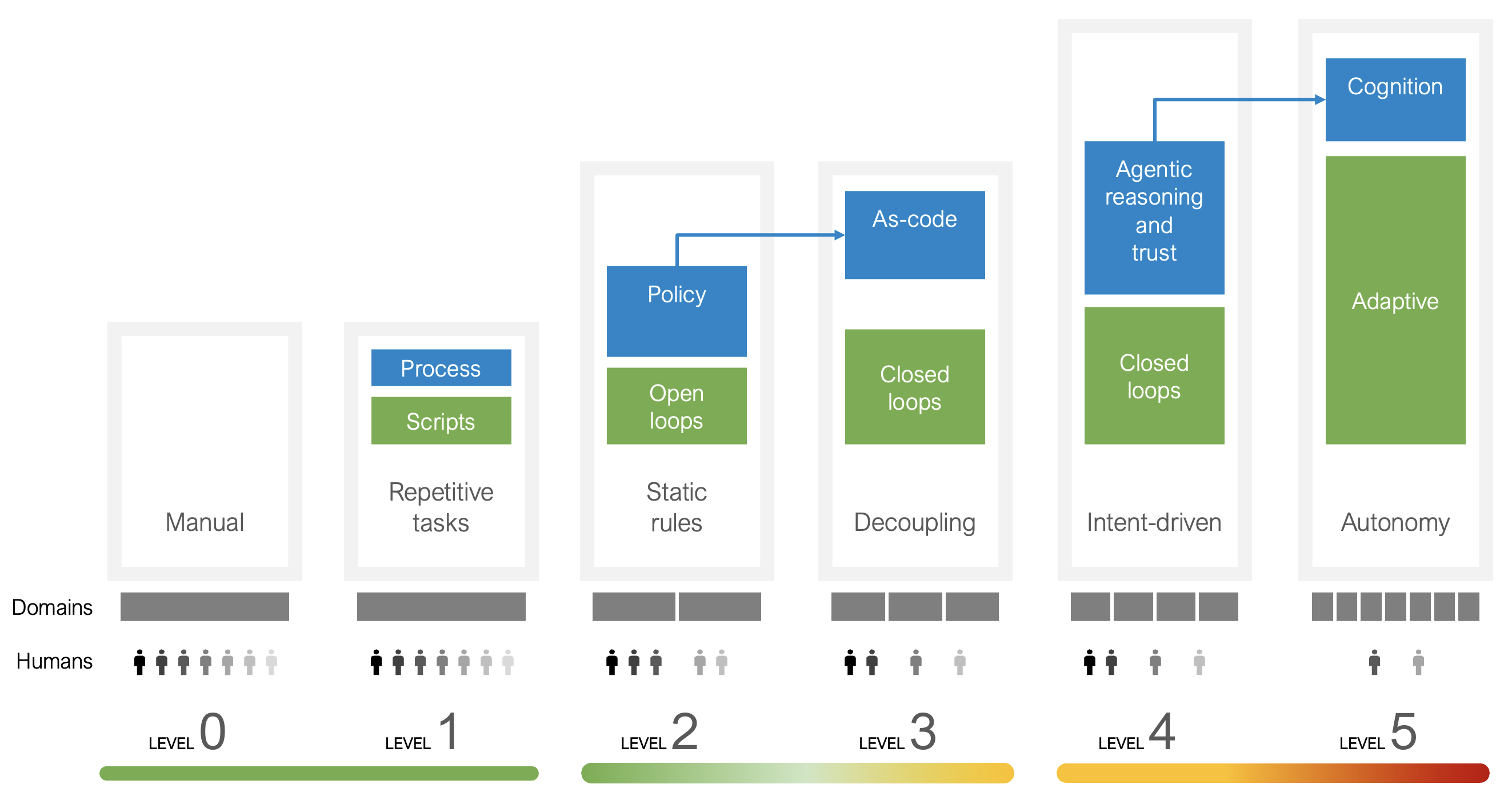
Levels of autonomy
TM Forum provides the common language, standards, architectural frameworks, and maturity models that operators and vendors rely on to build, measure, and deploy increasingly automated and intelligent network operations. At the core of this effort are the Autonomous Networks Framework and the Autonomous Operations Maturity Model, which outline the five levels of autonomy and establish the capabilities required at each stage.
- Level 0: Operators rely on manual processes with limited automation
- Level 1: Assisted operations, where predefined workflows and analytics support human decision-making
- Level 2: Partial autonomy, enabling systems to execute automated actions under human oversight
- Level 3: Conditional autonomy, where intelligent systems can interpret intent, coordinate across domains, and independently resolve most issues while escalating edge cases to humans
- Level 4: High autonomy, focused on service and customer experience, with AI/ML-enabled, predictive, cross-domain automation for complex analysis and decision-making
- Level 5: Full autonomy, with a self-governing network that continually learns, optimizes, and adapts in a closed-loop system without human intervention
Together, these stages define a roadmap for communications service providers (CSPs) transitioning from traditional, reactive operations to proactive, intent-driven, and ultimately autonomous networks.
Use cases for autonomous networks
Bandwidth on demand: Automatically scale network capacity up or down in real time based on policy or user requests, ensuring that applications get needed bandwidth without manual intervention.
5G network slicing: Automate instantiation and scaling to optimize multiple virtual slices with different SLAs over a shared 5G infrastructure. Each application receives tailored performance without manual reconfiguration.
Automated service assurance: Move from static, manual operations to an automated, cloud-like network, using multi-domain orchestration and network control to deliver dynamic network services faster and with closed-loop assurance.
Network as a service (NaaS): Enable on-demand, intent-driven connectivity that dynamically configures, optimizes, and assures itself across multi-domain environments with minimal human intervention.
The role of agentic AI
AI is fundamentally reshaping how service providers operate their networks. Modern network assurance, inventory, orchestration, and planning platforms increasingly embed AI capabilities—from graph-based correlation and predictive analytics to intelligent workflow automation—to replace static, rule-bound processes with dynamic, data-driven operations. When AI is directly integrated into the operational fabric rather than bolted on, it accelerates fault isolation, reduces repetitive manual tasks, improves service quality management, drives optimized multi-layer designs, and enables more proactive network behavior. This AI foundation empowers operations and planning teams to move from reactive troubleshooting to predictive, customer-centric service assurance and to achieve measurable improvements in efficiency, reliability, and experience.
Agentic AI elevates this shift by enabling networks to act on high-level intent through autonomous, coordinated decision-making. Intelligent agents work across inventory, assurance, orchestration, planning, and routing domains to interpret goals, analyze context, and execute multi-step actions with limited human involvement. These agents rely on unified data models, real-time telemetry, robust API access, and secure integration with language models to reason about network conditions and drive closed-loop automation. By translating intent into orchestrated actions, agentic AI brings the industry closer to true autonomous networks—systems that adapt, optimize, and self-heal by continually learning from operational outcomes and evolving demands.
Learn how to thrive in the AI era
Accelerate the journey to autonomous networks
Ciena and Blue Planet is a trusted full-stack path to autonomous networks, with AI-ready operations support systems (OSS), multi-layer control, and programmable infrastructure working as one.
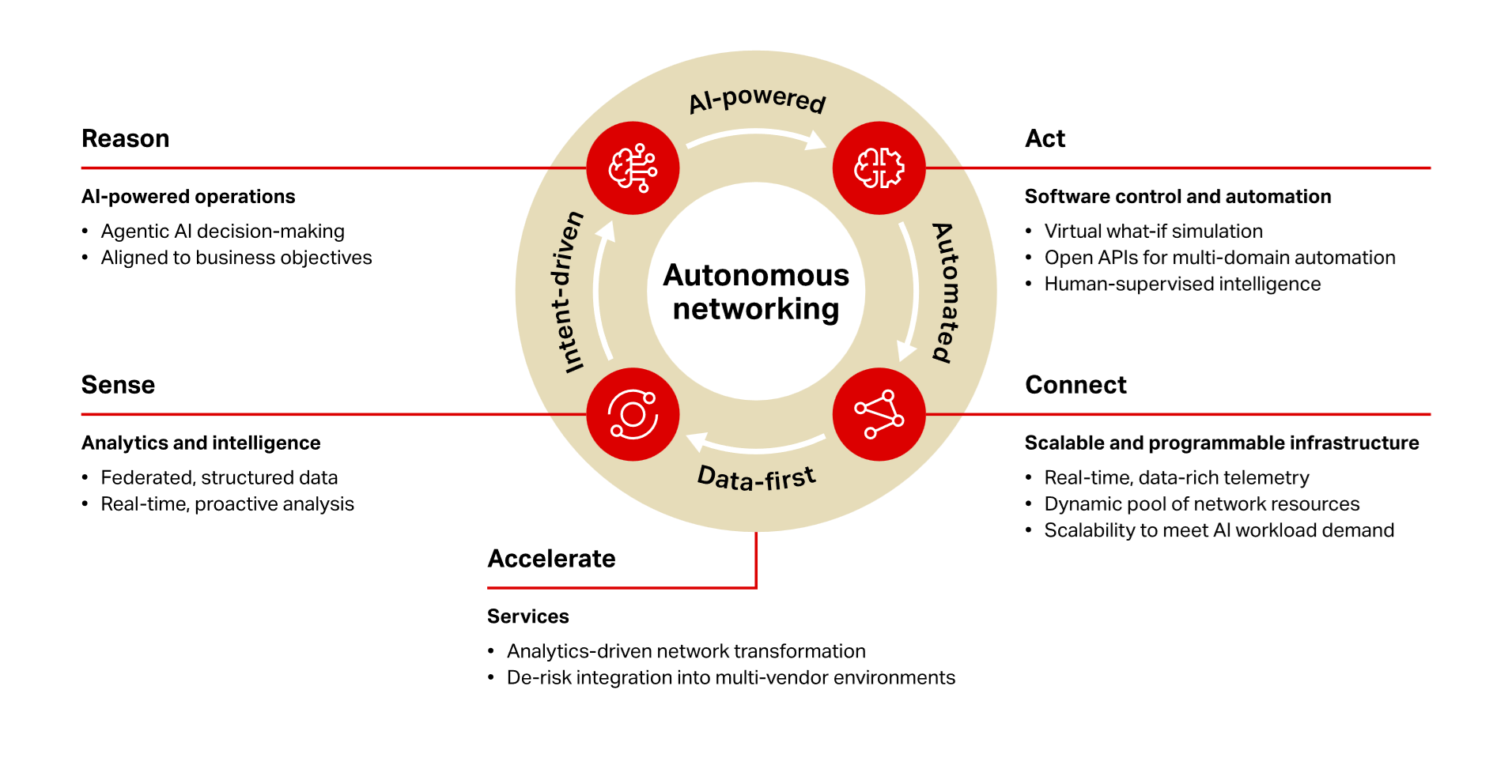
Figure 2. Autonomous networking with Ciena and Blue Planet
Scalable and programmable infrastructure: Highly programmable, scalable, instrumented network elements perform intelligent on-box processing and send enriched, real-time telemetry upstream to network control and operations systems.
Analytics and intelligence: AI technologies collect and analyze multi-layer, multi-domain, multi-vendor streaming and historical data to enable proactive prediction and decision-making, plus rapid support for new use cases.
AI-powered operations: Embedding agentic AI into decisions turns static rules into dynamic, closed-loop operations guided by intent. Align every action with experience and business goals while shifting from OPEX-heavy management to growth-focused innovation.
Software control and automation: Customer-centric intent is enforced by orchestrators and controllers across multi-layer, multi-vendor domains through open APIs. Human oversight tapers as confidence in closed-loop automation grows.
Services: Deep domain expertise across network and operations enables faster deployment of agentic and generative AI capabilities, integrating them into end-to-end workflows.
Related products and solutions
Blue Planet Intelligent Automation Portfolio
Blue Planet is an AI-ready, cloud-native OSS platform. It unifies inventory, orchestration, and assurance, applies agentic AI to end-to-end intents, and drives closed-loop automation across multi-domain, multi-vendor environments.
Ciena multi-layer network control
Ciena Navigator Network Control Suite™ provides intelligent, multi-layer network control that unifies visibility, analytics, and automation. Dynamically plan, optimize, and assure services across complex networks where Ciena platforms are present.
Ciena programmable infrastructure
Ciena offers a highly programmable infrastructure of optical and routing products that expose rich real-time telemetry and open interfaces. These offerings feature a dynamic, software-controlled foundation that AI and automation can continually optimize.