






Although the concept of a network digital twin (NDT) is not new, there hasn’t been a compelling catalyst to drive widespread adoption of NDT solutions over the years. Now, in the AI era, as operators move towards autonomous operations, both the feasibility and usefulness of NDTs have increased to the extent that they are becoming a reality. Ciena’s Marie Fiala explains the shift to AI-native digital twins.
Given the complexity of networks, across wide-reaching geographies, using an array of hardware and software technologies, it has been difficult to grasp how a network digital twin could be implemented in practicality. It seems like an attempt to boil the ocean. How can one create a virtual replica of a physical network, including its devices, connections, and behavior? Wouldn’t that require the same amount of resources as the actual physical network? Today, networks are scaling at unprecedented rates, due to AI workloads, so the twinning conundrum seems even more daunting.
In an earlier blog, we defined a NDT as a virtual representation of the real-world physical network, which is kept synchronized in order to simulate, analyze, and optimize physical network behavior. And herein lies the key technical question: how much and how often does synchronization need to occur, in order to derive desired benefits, across an array of operational and planning use cases?
AI as a driver, AI as an enabler
There is no doubt that AI is positively impacting network operations. A recent survey of AI in telecoms, conducted by STL Partners, uncovered that AIOps is delivering the biggest ROI for service providers, in comparison to other functional areas, with 22% of respondents citing operational cost savings of >10%. No wonder that a large number of operators are keen to increase their level of network autonomy! Yet, in another global study by Omdia, ‘Automation and AI for Transport Networks’, the top concern regarding the deployment of agentic AI was the accuracy and reliability of AI-driven decisions, cited by 45% of respondents.
How to mitigate this concern? One key method is to validate AI decisions within a twin environment in advance of having them enacted on the actual network, making NDTs the decision engine of agentic AI systems. So, the perceived risk of AI decision-making is an important driver for NDT adoption. Interestingly, on the flip side, the power of AI also enables the NDT implementation itself, within an agentic AI framework.
Intelligence inside
Here’s the crux of an efficient NDT implementation: there is no need to twin the entire network at all times. It’s true that network operators need to have a comprehensive, holistic view of what’s happening in their network in real-time, to perform day-to-day operations. This is achieved with a powerful network controller – such as Ciena’s Navigator Network Control Suite (Navigator NCS). However, when evaluating a particular operational decision, one needs to hone-in on the specific network area and behavior, and the desired outcomes. This approach enables a NDT to scale effectively alongside the physical network, efficiently use compute resources, respond in a timely manner, deliver solid results, and build the operator’s trust with AIOps.
The NDT can twin with the physical network in real-time for the task at hand, provided it already has both an internal, comprehensive graph-based model of the network and reliable data pipelines for consumption of network performance metrics and state changes. Of note, the network model should include correlation across layers – optical, optical transport network (OTN), Ethernet, IP, and connectivity services – so that cross-layer dependencies and impacts are well understood. A critical underlying requirement is that the network itself is clean – refer to my previous blog on that topic – otherwise the twin environment will reflect the same inaccuracies and won’t yield the best results.
In this way, the NDT can synchronize its network view just-in-time in context of what is being asked, ensuring an accurate and safe environment for validation of network changes. It provides a feedback loop for other AI agents – such as the network observability agent – and leverages network-specific tools to assess the network impacts of proposed changes or hypothetical failure scenarios, using standard Agent2Agent (A2A) interfaces and model context protocol (MCP), respectively. Next, the NDT interfaces with other AI agents to enact those changes as part of human-supervised control loops – at the level of autonomy with which the operator is comfortable.
Ciena’s Navigator NCS encompasses exactly these described architectural pillars in Ciena-based networks. Unlike legacy digital twins that rely on static models or offline simulations, Ciena’s Navigator NDT provides:
- Contextual twinning for decision validation at scale
- Real-time data pipelines for state and telemetry ingestion and synchronization
- Native multi-layer knowledge graph for IP/optical correlation and insights
- AI agent industry standard APIs for integration with other systems and tools
- Closed control loop with human-supervised automation
High-runner use cases
Network optimization and traffic engineering, as well as network performance monitoring, were ranked as most suitable use cases for digital twins, as per the respondents in the aforementioned Omdia survey of service providers (selected by 46%, and 43% of respondents, respectively). In our own customer discussions, they’ve prioritized the following use cases, taking into account key objectives such as bandwidth and latency:
- Proactive network assurance to ensure service performance
- Reactive repair in the event of network troubles
- Planning for network capacity augments
Ciena’s Navigator NCS agentic AI framework includes a NDT as described above, which can validate a complex multi-layer network scenario to verify whether it meets the desired intent. In particular, Navigator NDT is founded on a comprehensive knowledge graph of the multi-layer network with high synchronization fidelity. It can be used to address the key use cases, listed above, in the context of a dynamic operational workflow.
An example network assurance use case is shown below, where the current photonic path is trending towards a performance degradation and our NDT is used to validate whether a new path will satisfy the performance and bandwidth requirements to safely carry the customer’s traffic. The operator can clearly see what will happen if the new path takes effect and can control the network change, to proactively mitigate adverse customer impacts.
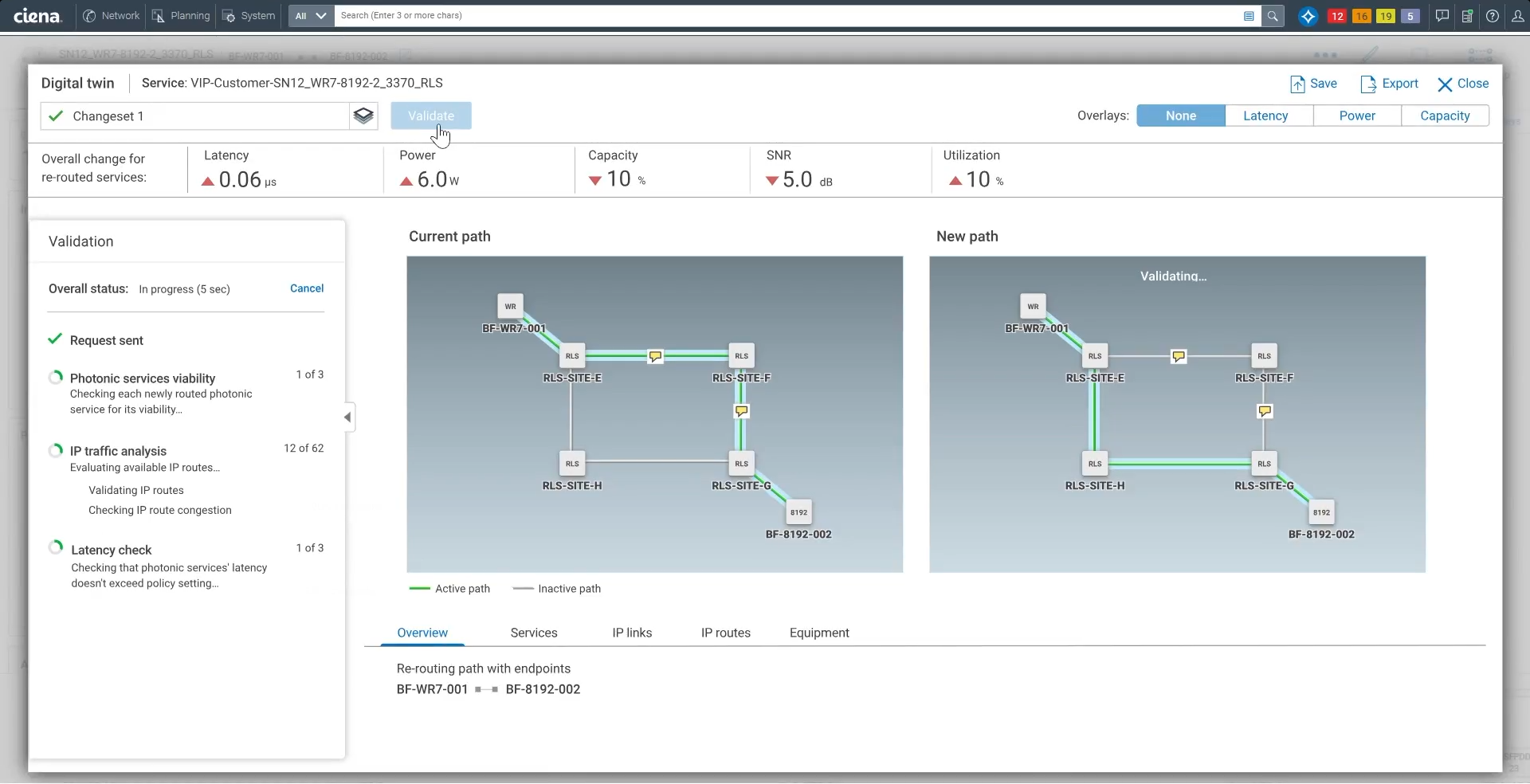
Figure 1: Example digital twin visualization of a service move validation
Moving ahead
The rollout of network digital twins within agentic AI systems is just beginning, yet their utility is already apparent. As you formulate your AIOps strategy and execute on it, NDTs are an essential component enabling autonomous networking. Look under the hood of potential NDT solutions and assess whether their foundational intelligence goes beyond generic AI and can accurately reflect the complexities of your network at scale – as does Ciena’s Navigator NCS – to take you to the next level of network autonomy.